
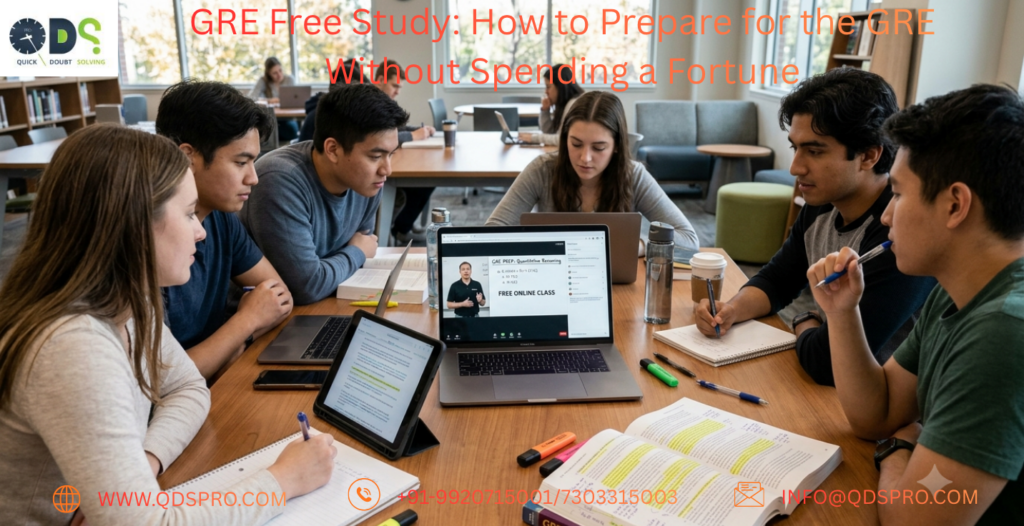
Preparing for the GRE does not always require expensive books, multiple courses, or a large study budget. With the right resources and a structured approach, GRE free study can help you build your foundation, practise important question types, and understand where you need improvement.
However, free preparation works best when you know what to study, where to find reliable resources, and how to turn those resources into a consistent study plan. If you are planning to prepare for the GRE independently, this guide will show you how to make your GRE free study plan more effective.
What Does GRE Free Study Actually Include?
GRE free study means preparing with resources that are available without paying for a complete coaching program. These may include official practice questions, sample questions, vocabulary resources, mathematics revision material, videos, practice tests, and study guides.
The most important point is quality. Not every free GRE resource available online reflects the actual test. Therefore, students should begin with official material and then supplement it with other learning resources.
The official ETS GRE preparation resources include sample questions, section overviews, mathematics review material, preparation videos, and practice options.
For reliable official information, students can explore the official ETS GRE preparation resources.
How to Build a GRE Free Study Plan
A successful GRE free study plan should cover all major areas instead of focusing only on the section you find comfortable.
1. Start With a Diagnostic Test
Before beginning your GRE free study, take a practice test under timed conditions. This gives you a starting point for understanding your current performance.
Record your mistakes separately for Verbal Reasoning and Quantitative Reasoning. Ask yourself:
- Which topics are causing the most mistakes?
- Are you losing marks because of concepts or careless errors?
- Are you running out of time?
- Which question types feel unfamiliar?
Your answers will help determine where your study hours should go.
2. Strengthen Your GRE Quantitative Foundation
GRE Quant preparation requires more than memorising formulas. You need to understand concepts and recognise how they are tested.
During your GRE free study, revise topics such as arithmetic, algebra, geometry, ratios, percentages, averages, probability, statistics, and data interpretation.
ETS provides a free Math Review covering fundamental concepts and exercises relevant to GRE Quantitative Reasoning.
After revising a topic, solve practice questions without looking at the solution immediately. Keep an error log so that you can revisit recurring weaknesses.
3. Make Vocabulary a Daily Habit
Vocabulary is an important component of GRE Verbal preparation. Instead of trying to memorise hundreds of words in a few days, include vocabulary in your daily GRE free study routine.
Start with 10–20 words a day. Learn each word through its meaning, usage, synonyms, antonyms, and example sentence.
More importantly, practise these words in context through Reading Comprehension and Text Completion questions.
4. Practise GRE Verbal Question Types
Your GRE free study schedule should include Reading Comprehension, Text Completion, and Sentence Equivalence.
Do not simply count how many questions you solve. Analyse why an answer is correct and why the other choices are incorrect.
This approach helps you recognise patterns and improves your decision-making under time pressure.
Can GRE Free Study Be Enough?
For some students, GRE free study can provide a strong starting point, particularly if they already have a solid academic foundation and can maintain a disciplined schedule.
However, studying independently can become difficult when you repeatedly make the same mistakes, struggle with timing, or are unsure how to approach difficult questions.
That is where structured guidance can help.
Students who prefer instructor-led preparation can explore GRE Live Online Tutoring for structured classes and guided practice. Those looking for classroom-based preparation can consider GRE Offline Coaching Classes.
For students who want personalised attention based on their individual strengths and weaknesses, GRE Private Tutoring can provide a more customised preparation approach.
A Practical GRE Free Study Routine
A simple weekly routine can make your GRE free study more productive:
Monday–Friday:
Spend 60–90 minutes on concepts, vocabulary, and targeted practice.
Saturday:
Complete a longer timed practice session and analyse your mistakes.
Sunday:
Review your error log, revise weak concepts, and plan the following week.
As your test date approaches, gradually increase the amount of timed practice. The objective is not merely to solve more questions but to improve accuracy, speed, and consistency.
Final Thoughts
GRE free study can reduce your preparation costs and help you build a strong foundation, but success depends on how strategically you use your resources.
Begin with official material, identify your weaknesses, practise consistently, maintain an error log, and regularly measure your progress. If you find that self-study is not giving you enough structure or personalised feedback, guided preparation can help you stay accountable and address specific weaknesses.
The right approach is not about using the maximum number of resources. It is about using the right resources consistently and intelligently.